Wednesday, April 16, 2014

What happened in Guatemala?


A key principle that we operate from as a ministry, and among our team here in our ministry is to: 1) only go to places where no other ministry is operating, and 2) where the pastors are in clear agreement to continued training and ministry together.  Thus, we were rather confused to receive 3 urgent emails from Guatemala over the winter inquiring . . .

"When are you coming back?"

"We have more pastors who want to come this time, how many more can come?"

"Can we do the conference next week?"

When we responded "How about the first week of March?"

They responded "We can't do the conferences right now."

(Something must be going on).

Now, let me first say that the church ("church" meaning all Christian believers, not just the "church" as in my church or your church) in Latin America is much more entrenched in divisions, jealousy and petty issues. To the same degree that the North American church is overwhelmed by consumerism (i.e.: select your favorite church, music, youth group . . .  you choose = consumerism vs. accepting (dare I say submitting) by faith to what God wants you to do). Pastors in Guatemala are distracted by similar issues that our Mexican brothers and sisters struggle with here in Mexico. The struggle is authoritarian denominations controlling church property and pastor assignments based on favoritism, sheep-steeling and almost every other conflict is then exacerbated by poverty. It's no surprise that the Gospel doesn't flourish in an area when so many pastors are distracted by issues of jealousy and division. In societies where corruption is expected in the public arena, the same corruption of the Gospel is being committed by its leaders! That's not good news.

Therefore, instead of conceding to the news of a closed door, we were genuinely interested in understanding what had caused such an abrupt change of heart within a group of pastors we had previously worked with. We cancelled the upcoming conference and quickly sent Pastor Marco and myself to Guatemala and Chiapas for a 5 day follow-up. First, to investigate the problems with the one group of Guatemalan pastors, and second, to help the pastors in Chiapas set up the next conference that we have been planning for this August. Many potentially fruitful connections resulted from our visit.

Since flying to Guatemala is actually cheaper than flying to Chiapas, we started in Guatemala City to visit 2 pastors we know in the capital, as well as, meet with the Guatemalan Bible Society. The GBS is starting a new ministry to offer training to pastors in the capital, and so we met with the director with the hope of establishing a partnership which would enable them to reach more rural pastors and for us to be able to establish experienced teachers within an existing structure (GBS) that could continue training pastors once we train the pastors to present the material. We're very hopeful that this connection will greatly magnify our opportunities to serve Guatemalan pastors.


Guatemalan Pastor Carmelino and his family

The following day we drove north from the capital to visit with the group of pastors who had suddenly changed their plans for the upcoming conference. Our meeting with them was brief, but we quickly discovered that a small group of pastors was responsible for raising funds for a multipurpose building, and that they didn't want anything to interrupt the completion of this building. While there is a group of pastors within their group that want to continue the teaching, we thought it would be better to remove ourselves from their conflict, and to leave another pastor outside of this group in charge of coordinating future conferences in northern Guatemala. Thus, we continued to visit additional towns close to the Mexican border over the next 2 days.


Pastor Marco buying a snack as we walk the streets in Tecun Uman, Guatemala

In the last town, we walked around asking people on the street, "Where's a good church around here?" or "Do you know a good pastor around here?" This is one of my favorite survey methods in new areas as it gives us a really good idea of how Christianity is operating (or not) in an unknown area. We met 5 pastors in 3 hours of walking through the town of Tecun Uman, some with tragic stories, some with business as usual stories. Few seemed interested in learning more, or would be able to. Resigned that maybe this was not the place of opportunity that we had felt when we passed through yesterday, we decided to grab a quick bite to eat in the plaza before crossing into Mexico for our meetings with pastors in Tapachula.


The Baptist church complete with extraordinary book store across the plaza in Tecun Uman.

As we were sitting eating fried chicken (fried food is sterile), I turned around and saw a cross on a green building across the plaza. As we only had minutes before we needed to head north, I ran across the plaza to find a small church and a Christian book store of the size and completeness that I've never seen anywhere in Mexico or Guatemala. We quickly located the pastor and explained why we were visiting his town. He told us that he would be interested in working together to start a training center in northern Guatemala because while there is training available in the capital, pastors from the north cannot afford to travel to the capital, and traveling north into Mexico is also dangerous for them (see below). Thus, after a brief introduction we left with the agreement to continue communicating with this great pastor. When we are feeling called to new areas, most of the time just showing up is all that is needed to open the door.


Google's satellite version of rafts crossing the same area in the picture below.

The Suchiate River which separates Guatemala (right) from Mexico (left).

Some of you might be thinking "Is it safe to walk around border towns?" Probably not. As a team we plan ahead, keep moving, and pray all of the time. Of all the risks we could encounter, it's seems like thus far, the driving is the most hazardous part of our ministry here. In Guatemala in particular, the highways are treacherous with huge unexpected potholes and very fast drivers. For Guatemalan pastors wanting to attend our conferences in Mexico, since most of them don't have visas to allow them entry into Mexico, they have to pass by raft over the river that runs between Guatemala and Mexico. Many other things come back and forth on these rafts all day and night into Mexico and Guatemala also, so this route is not safe for anyone.


Very public transportation in Guatemala.

Another paradox in Guatemala is that evangelical churches are about as common as Starbucks or McDonald's in the US. You would think that with that many churches, a country would generally be safer. Sadly this is not true. Even in the smallest town, every pharmacy, fast food restaurant and even cell phone stores employ security guards carrying shotguns. Think of it as small scale mutual deterrence.


Dunkin Donuts in Guatemala: Those are some very valuable donuts!

As we passed into Mexico at dusk after walking through Tucun Uman, I was suddenly surprised to feel a sense of relief as we came to the "Welcome to Mexico" sign. Funny that Mexico suddenly felt "safer," like we were home now.


Crossing north into Mexico from Guatemala.

Our meetings with the pastors in Chiapas were even more fruitful than we expected. They have formed a committee to coordinate the next conference there this August, and they are well organized.  There are so many more things to say about the progress we are seeing in Chiapas with the pastors, but if you've hung in there to read this much, thank you. We're thankful to be serving the pastors in this way, and thankful for YOU who read, pray, encourage us, and support us.


Coming home is always better!

Pastor Marco with some of his family.

Monday, November 25, 2013

INVASION

At least that's what we would call it in the US. Last Saturday morning at 3:25am, I awoke to see someone rummaging through our living room/kitchen area with a flashlight. My first thought was that Ethan was trying to find something before heading out to take pictures early in the morning, which he often does around 5:30am.  

Wait, it's 3:25am!


That's not Ethan then.


This is not good (I start yelling and stumbling out of bed).


If you've woken up in a potentially life-threatening situation (at least that is what some primitive part of your brain is telling you, you are in), then facing an intruder half-asleep doesn't leave you with alot of "if-then" scenarios that tell your still sound asleep frontal-lobe what you should do next. I started shouting, not realizing that the implication of telling a thief to go away is inviting them to leave WITH whatever stuff of YOURS they already have.


This thief doesn't expect someone to wake up, so he takes off across the patio, onto the first balcony, across to our entry stairs, and down to the street. I run back to get the keys, run outside and see no one. I drive around our small town looking (and what would have I had done if I had found someone?), but there is nothing. When I return to the house I notice that the thief left Colleen's purse in the driveway, along with an electronic picture frame that he didn't have time to grab. Inside her purse are STILL our passport cards, visa cards, credit cards, ID's etc. Only the cash is gone, an older phone, and her prescription sunglasses (not the easiest thing to sell, I would think). WOW.


Before moving here, we read plenty of books which described late-night burglary as common in Mexico (it is), but when you actually see someone INSIDE your house it adds a dimension of reality that motivates you to check all the locks, install some very prickly plants at easy access points, motion lights, etc. And then, we pray. Actually, we've always prayed since landing here that God would protect us, and I believe he did. If the thief had not been greedy and had only taken Colleen's purse and ran, I would have never woken up when he came back the second time for more stuff. We would have been gloriously inconvenienced with loss of bank cards, visas, passports, ID's . . . etc. Instead, the thief returned, I woke up, and he made out with $250 in cash, a cell phone, and a pair of scratched sunglasses that are worth nothing to anyone except Colleen.


Our Mexican friends here had various responses from filing a police report (we did), to calling all of them, next time, so that they could hunt down the thief with shovels and bricks. So the next morning, after my 3:25am wake-up call, I showed up at the Ministerio Publico at 10am only to be told that the person who takes reports is not there. After buying prickly plants (4 large agave plants, 4 large fired pots, 4 iron pot stands, and soil for less than $100USD!), I return at 1pm. The office is totally closed. A helpful traffic cop says that they usually don't close until 2pm, but . . . they do open from 6-10pm. I return at 6:30pm just in case they decide to open late. One woman is alone in the office and after some help from another traffic cop (their offices are in the same building) she reluctantly lets me in. "Why didn't you come earlier so we could get fingerprints?" she says. "Funny you should say that," I reply. For the next 2 hours, she carefully records my report on her manual typewriter. I snap a picture while she is away making copies of the report, none of which I receive. She tells me that she'll be at my house at 11am the next morning (Sunday). We're ready by 10am. 11am nothing, 12pm, 1pm, 2pm, 3pm, 4pm still no one. At 5pm we decide to head to the beach. When we return our neighbor says, "Hey, the police came 5 minutes after you left!". I'm still trying to track them down. Two nights ago our neighbor was broken into. The thief cut a line down the screen door and helped themselves to the guests' cell phones (it's hot here, so their sliding door was open for ventilation). I installed a photo eye that I've wired to a wireless doorbell to tell us when someone is coming up the stairs.


The desk of the licenciada at the Ministerio Publico.

Despite the frustration of loosing a few things, our response to this little incident has actually connected us to more people here in our little town and in the larger town close by. We have reflected on how much we value "stuff" versus "people" and are still very thankful to be here.

I just finished reading Richard Wurmbrand's
In God's Undergound with Ethan, and we had just read a few nights before, the section below. Let the radical nature of this rabbi's concern for a person's soul reset your love for people, even the people who might seek to hurt you or steal from you.

"I answered by telling the story of a famous rabbi who was living in the Ukraine in Czarist times, and was once called upon to give evidence in defense of a follower. The noble looks and spirituality of Rabbi Hofez Haim impressed the court, but the old man refused to take the oath; he was unwilling, he said, to involve God's name in his evidence. The prosecution protested, "We must have a guarantee that he is telling the truth." The defense lawyer rose. "Your honor," he said, "may I mention something that will prove the character of my witness and show that we can accept his evidence, even if, for religious reasons, he cannot be put on oath? Rabbi Hofez Haim often goes from shop to shop collecting money for the poor. One day a thief knocked him down and snatched the purse containing the collection. The rabbi was upset, not so much at the loss of the money, which he instantly decided to replace from his own small savings at home, but at the harm done to the thief's soul. He ran after him calling, "You have no guilt before God; it is my money and I give it to you freely! The money for the poor is safe at my house! Spend what you have taken with a clear conscience."

How concerned are we about another's soul? Are we concerned enough to ignore whatever losses we incur for the sake of another's soul?

Wednesday, October 16, 2013

Pastors Conferences in Chiapas and Guatemala


Pastor Marco teaching exegesis with iPad and projector

THE JUMP TO LIGHT-SPEED (or at least the 21st century)


Adapting to new technology

One of the added benefits of being able to live here full-time is the opportunity I have to mentor people. Of course, I have my mentors as well, both in the US and here in Mexico, as I seek input to clarify and correct our work here. This picture here of Marco teaching using an tablet and LCD projector represents a significant milestone in my work here equipping pastors.  For the last 8 years, we have


A registration table!

used overhead projectors and transparencies to help pastors take notes during our teaching, and to graphically illustrate concepts in our teaching. The plus side of an overhead projector is it's simplicity, but with most of our teaching arenas being outside, the visibility of the transparencies were usually very poor. One of my goals this year was to train our team to use tablets connected to projectors to annotate digitally while teaching. As you can see from the pictures, the image is very clear which is really important when the pastors you are teaching are partially illiterate. What I had planned to be a slow roll-out of technology turned into an instant transformation when the overhead projector we were attempting to use was too dim to be readable. During the first lesson, we quickly set up the tablet and projector, which we already used for worship slides, and after a crash course in annotating a PDF on a tablet, we were off and running.  Amazing.

BLESSING AND BEING BLESSED

Despite the fact that we are constantly invited to teach conferences throughout Mexico, we always question our motives: 1) Whether we are reaching out to the right people?, and 2) What kind of longer impact on their on communities will training pastors to more effectively teach and understand the Bible have? These are questions we wrestle with as a team, and so we evaluate each conference based on the responses of the pastors and churches where we are conducting each conference. Previous conferences in Chiapas (southern Mexico) were well-received, and culturally the pastors in Chiapas are some of the most studious pastors I have ever met. There are also other indicators, which both stand out as evidence of sincere need and genuine thankfulness, in the thorough attention to detail that churches put forth in their preparations to host conferences. We request very few items outside of a sound system for music and teaching. The churches provide the food, coffee, and in this case (see picture above) 3 people who set up to register pastors as they arrived for the conference. Being that this used to be my principle task, to register pastors and create name tags, I was both very impressed and relieved at the same time! An even more humbling event at both conferences was a formal presentation of gifts to us from each group of pastors. These were distinct groups, and yet each group expressed their appreciation to us by presenting us with these small gifts, which we understand to be indicators of the value these conferences have for these pastors.


Public transportation

DIFFERENCES


to feed his younger brothers

A boy of 16 earning money on the
street by blowing gasoline on his flame

As we intentionally seek out areas of need in Latin America, we are constantly reminded that we are further and further away from the comforts of home, even comforts my Mexican leaders are accustomed to. As we were eating breakfast our first morning in Guatemala, one of our leaders remarked at how terrible the food was. "That's why we're here," said another leader. Indeed. I neglected to snap a picture of the ubiquitous armed guards that stood in front of almost any shop or restaurant, from a fried chicken fast-food (read KFC-ish) to a small cell phone shop, all of them had at least one guard with a shot-gun and bandolier of shells around his chest. It's a disconcerting thought to see  where the balance between peace and violence rests in the hands of an armed guard who makes less than $5/day. Just crossing into Guatemala makes Mexico seem like the US in comparison. The sense of desperation and hopelessness on the faces of the people, and the way in which everything from toothpaste


Traveling to the conference in Guatemala.
No kidding its safer this way!

to medicine to computers costs so much more for people who make so much less.


End of the conference in Guatemala.


MENTORING FOR CHANGE

There has been some movement in the last few years towards using technology to teach pastors remotely in developing countries. While there are great benefits in getting tools and resources into the hands of pastors quickly, as a team, we feel called to mentor and disciple great leaders. As in a business, you wouldn't hand a book to an employee and expect them to become a model employee, you have to walk them through the material and verify that not only do they comprehend it, but that they could teach someone else the same material. We're doing that, and trying to take it a step further. As we have conducted over 20 conferences and trained over 900 pastors in Mexico and Guatemala, we have accumulated a short-list of pastors, who have displayed the ability to mentor other pastors. We are working with them to encourage, coach and mentor them so that they can transform their communities.

Tuesday, October 8, 2013

Our Life in Chacala . . .

On this "Fall" day, it is 92 degrees outside and 88 degrees inside, so as I write to you, the fans are blowing and the sun is shining. I'm having a hard time welcoming in the new season without much evidence of change, except for the few Fall decorations we brought with us, but such is life in the tropics. We can live vicariously through all of your photos & tales of the changing seasons!

As some of you might be curious as to where we have landed, after uprooting our lives in Escondido of 13 years, I wanted to share with you what our life looks in Chacala through a "tour" of sorts. Now that we're settled in, the school year is in full gear, and we are gearing up for our next pastor's conference here in Chacala, there's no time like the present.

Here's the village of Chacala, on the north end with the beach on the north side. This is about 2 hours north of Puerto Vallarta via automobile.


Here is the main "street" with a few hotels, restaurants, street tacos, and tiendas (groceries & gift shops).


Here is the Plaza with the Chac Mool restaurant in the background.


Here is the fish market, where fresh fish comes in daily from the nearby harbor (below). 
Fishing is one of the main occupations of local residents, next to tourism.


Here's the local market where we buy the basics: bread, fruit, veggies, milk, yogurt, chips, soda, and ice. Anything more, we need to go to the nearest town, Las Varas, which is 20 minutes away. Most other things, we shop for when we go to Puerto Vallarta (2 hours away); at Costco, WalMart, or other big chain grocery stores.


Then it's off to Alistair's kindergarten . . . just a small walk towards the harbor from this store.


This school is for 3, 4, and 5 year olds. The classroom is the light orange building (below). The purple building is where the teacher sleeps and lives all week. His home is a ranch an hour away, so he commutes by bus on Monday and Friday (this reminds me a bit of Little House on the Prairie). The tiny red building under the tree has a tiny kitchen and bathrooms for the kids. The families of the 6 students are on a rotation to provide a substantial snack for the students & teacher each day at 10:30am. School is from 9:00am to 1:30pm. The salmon colored building in the background is a vacation home/rental house.


Below,  a student is given a book to "read" (describe what they see) as they look at the pictures. Amazingly, Alistair is really enjoying school now after a few really rough weeks.


Back in town, don't forget our favorite pizza place . . .


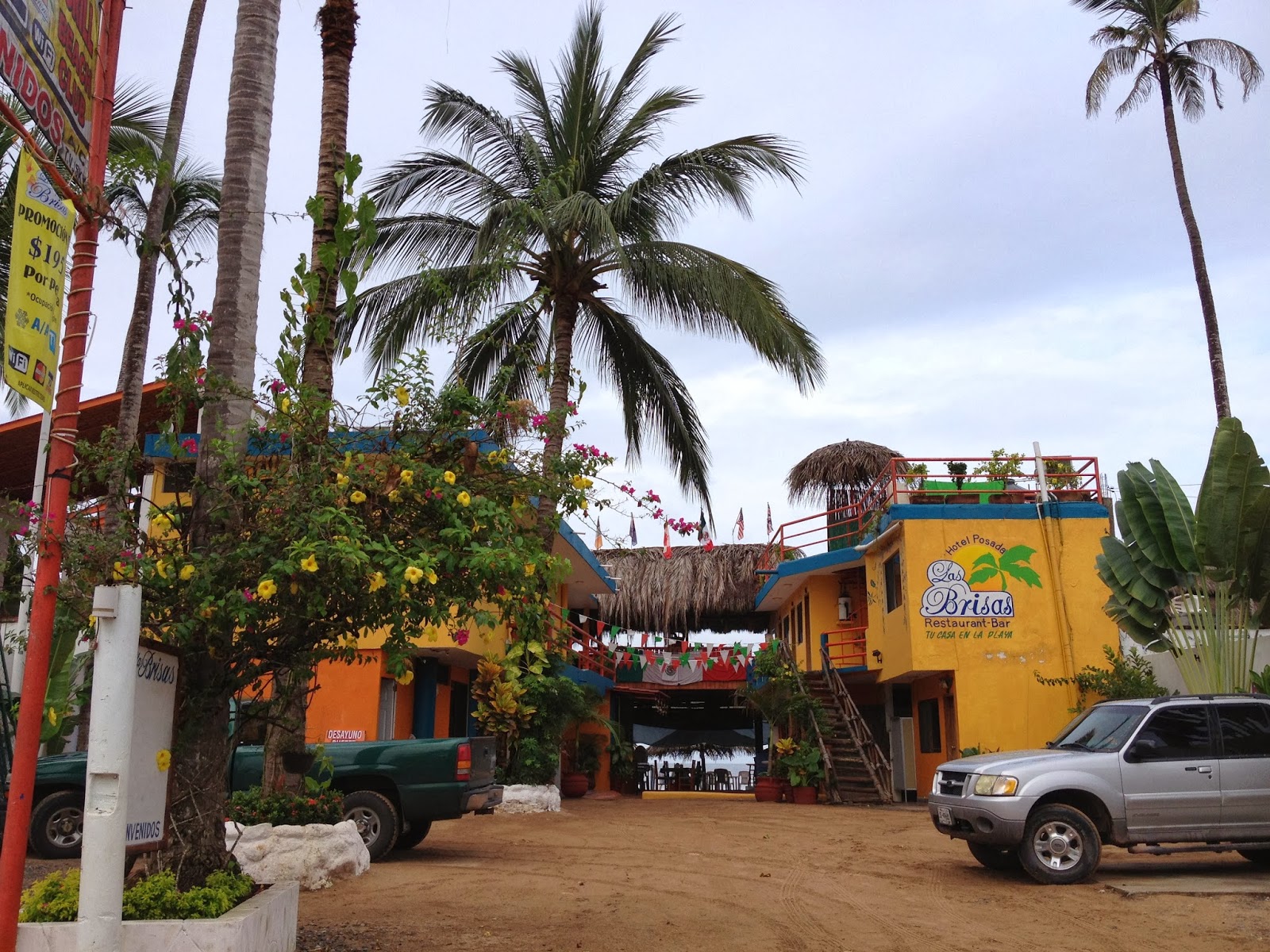
And our favorite hotel & restaurant, Las Brisas . . .


Now leaving "downtown",  you head up the hill towards our house. Here in the foreground is a small lagoon filled with lily pads (dark green). Then in the distance is another lagoon that is light green, where the local crocodile lives. Then beyond that, where the palm trees are, is a campground right on the beach and amongst the coconut trees. On the weekends & holidays you will see a handful of big tour buses lined up here. In the very far distance is a hill of mango groves, which was once a volcano, and you can hike up to see the crater.


Back to the main road, where the clinic is on the left (pictured below) and the turn off for our house 
is to the right.


If you continue straight here for another 100 feet on the main road, you would come to this great park.


If you were to turn right from the clinic, this is what you would see, our road. After the rains, it has become more of a 4 wheeling practice course, great for mountain bikes. The house you see here is not ours, but our neighbors, we are directly across from him to the left.


Here's our place . . . built on the rocks.


And if you were to come visit, you might find this guy waiting to greet you. 
Alistair calls him "Brown Guy".


These are our neighbor's bananas, almost ready for harvest.


And of course Sydney and Ethan working hard on their schoolwork.


I hope you enjoyed your tour of Chacala!  

With all of these sights, please don't forget the wonderful people that live here (more introductions to come later) along with the plethora of mosquitoes and other exotic insects and animals all thriving amongst the heat and humidity.


Tuesday, July 30, 2013

My "neighbor" Juan


Our closest "hospital" in Las Varas. Juan is in the first bed, being examined by a doctor. The patient in the next bed is being treated for anaphylaxis from a scorpion sting. The boy looking at the laptop on the left is a child of one of the staff.


One of the things that we struggle with here are needs. Needs are everywhere. Sure, in the larger cities here, life seems almost normal with running water, electricity, internet, but even in large cities there are huge needs. Just to be able to keep our heads on straight, I think we sometimes avoid the needs so that we don't get overwhelmed and try to fix everything. So after doing ministry in Mexico for over 10 years now we have attempted to be selectively compassionate. Sounds lame huh? Well, it is frustrating to see so much need, and not be able to do more, but we are trusting that our focus on equipping pastors will facilitate better growth and health in each community where those pastors minister. Sometimes however, we can't ignore a need that God has clearly put in front of us. The death of Juan Borrayo (last newletter) just a month ago was a reminder to us that life is faster and shorter here. Thus, when our friend Juan (the town painter) fell sick a few weeks ago, we tried to help him with meals, but he never got better. Last Friday, I decided that Juan looked so bad that I should take him to a hospital (above) and so I did. Medicine in Mexico is a la carte for the most part, so if you need a blood test, you have to go to a separate lab across town for the blood test. Fortunately, the results are ready in hours not days like the US, but then you have to run the results back to the doctor. Juan's initial bloodwork (I'll spare you the full details) showed anemia, elevated white blood cells, and severely elevated platelets. The doctor at the first hospital recommended that Juan go to another hospital closer to Puerto Vallarta, so I drove him there. When the doctor at the second hospital saw the results from Juan's bloodtests, he thought that there must have been a mistake at the lab and ordered another round of tests. Unfortunately, these came back even worse: Hemoglobin 7.2, Platelets 1125, WBC 11. The doctor said he wanted to get Juan on a IV, so he wrote out a prescription.


Doctor in San Pancho literally typing out his notes.

Now since they wanted to keep Juan overnight, I went to the pharmacy (below) to buy IV fluids, IV vitamins, a bottle of water, and toilet paper, since the hospital doesn't provide those things. They will feed you, but no water, and no toilet paper.


Local pharmacy located right across the street from the hospital.

So Juan spent a very uncomfortable, sleepless night in the hospital, and I picked him up the next day. Hoping the hospital had given him medicine to thin his blood (they did not), I arrived to find Juan still in pain and with a prescription for antibiotics for an infection and a recommendation that he see an internist, when he gets on the equivalent of Mexican medicare "seguro". With the generous help of some of our donors, I paid the bill and took Juan back to Chacala. Fortunately, since then we have been able to get the paperwork started to help Juan get on "seguro", and hopefully get him to an internist who can properly diagnose his condition. We were able to email his blood tests to a prominent doctor in San Diego who was much more alarmed at Juan's results than folks were here. I think the lack of response by the local doctors is because they are so overwhelmed by people showing up with such difficult situations, and they clearly don't have the same magnitude of resources that we are accustomed to back in the US. As I went to check on Juan today, I was thinking of the parable of the Good Samaritan in Luke 10:29 where a man asks Jesus "who is my neighbor?" I know I have neglected many "neighbors" in my life who have been in need, but I'm thankful that in this very small situation we were all able to help our neighbor Juan.  I'll post another update on Juan when we know more.

Wednesday, July 3, 2013

Car Wash - Local Style


Here's a local car wash (the best one I've found so far) where we take our car (the white one) to get washed, and bonus, providing you bring the filter and oil, they will change your oil too. The car doesn't look that dirty you say? True enough, but you should see the inside! Now, when we first starting using local services here over 8 years ago, I had the same reaction you might have of how different things are here.  Most things here are built for utility with very little attention to form. So when you come from the land of smooth roads, clean sidewalks, air conditioned businesses with manicured lawns and gardens, your first impression here isn't a good one. Also, I have encountered enough folks here who seem to see dollar signs when they see my face, that I started to become wary of every transaction that I needed to make. Over time, I learned to take notice of details that would result in dependable service. At a car wash, it is subtle things like having a key rack to hang the keys for each car, speakers for the sound system spread apart to provide ambient music (read: not a overly loud ghetto blaster), and chairs for clients to sit in while their car is washed are small things, but indications that they care about their business. This one even had a recycling bin. Big deal you say?  In a country where many folks just toss their trash out the window (even while driving through the middle of town!), a business that voluntarily maintains a recycle bin (there's no $ in it for them) is significant. A complete wash, vacuum and windows cleaned is around $6 USD.  With today's oil change it will be around $10 USD including tip.